What Is Clawdbot? Why Shouldn't You Miss It?
In this article, we explain why Clawdbot and Moltbook, which have taken the world by storm in recent days, are developments you should not overlook.
In this article series, we will explain why Clawdbot and Moltbook, which have taken the world by storm in recent days, are developments you should not miss. In this first installment, we look at what Clawdbot is, why you need to keep up with these developments, and who should be using Clawdbot.
Since last week, Clawdbot (or, by its new name, “OpenClaw”) has become a piece of software that everyone, whether or not they care about technology, seems to be talking about. We do not often see software aimed at a niche audience with programming knowledge become a topic that even an ordinary passerby passionately debates.
So, does Clawdbot really deserve all this attention? What exactly is Clawdbot?
Clawdbot is a personal assistant that, like ChatGPT, has an AI model at its core. What sets it apart from peers like ChatGPT or Gemini is that it has access to far more tools, can use those tools freely, and, most importantly, can keep working for you while you are busy with something else or asleep in bed.
Clawdbot can complete the tasks you give it on its own, send you messages on WhatsApp to update you or ask for guidance, and even figure out which capability it lacks and acquire a new “skill” through a site called ClawdHub.
The idea of having a personal assistant that handles the tasks we find exhausting is, I am sure, appealing to many of us, even if it remains a dream for most. Many people, chasing exactly that dream, installed Clawdbot and tried to make it real. Did they succeed? That part is a little complicated.
But first, if you like, let us take a look at the story of Clawdbot and its creator, Peter Steinberger.
Clawdbot’s creator, Peter Steinberger, is Austrian. In software circles, he was best known as the former CEO of PSPDFKit, at least until Clawdbot.
After selling his former company, Steinberger began developing Clawdbot in 2025 as a personal hobby project. He named it “Clawdbot,” inspired by the English word “claw” and by Claude, the most popular coding AI model. As if foreshadowing the success story we see today, the project quickly became a focus of attention in the open-source software community.
But the real explosion came in January 2026. Helped by a model like Claude 4.5 Opus, which showed a major leap in computer use and coding ability, many people began sharing interesting ways to use it.
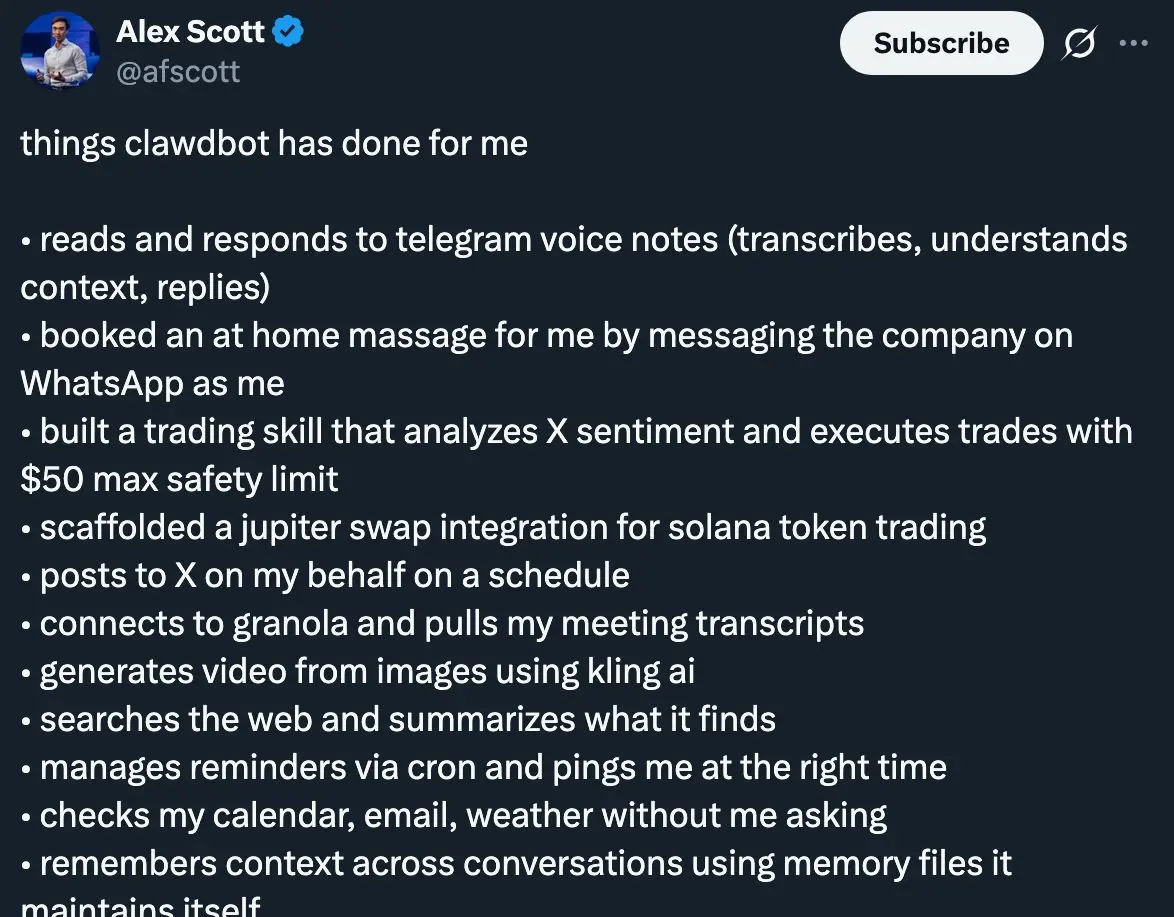
User @afscott:
“things clawdbot has done for me
- reads and replies to Telegram voice notes (transcribes them, understands the context, responds)
- booked an at-home massage appointment for me by messaging the business on WhatsApp on my behalf
- built a trading capability that analyzes general sentiment on X and trades with a safety limit of no more than $50
- laid the groundwork for a Jupiter swap integration for Solana token trading
- posts on X for me according to a specific schedule
- connects to Granola and retrieves my meeting transcripts
- uses Kling AI to turn images into video
- searches the internet and summarizes what it finds
- manages reminders via cron and notifies me at the right time
- checks my calendar, email, and the weather without me asking
- remembers context across conversations using memory files it manages on its own”
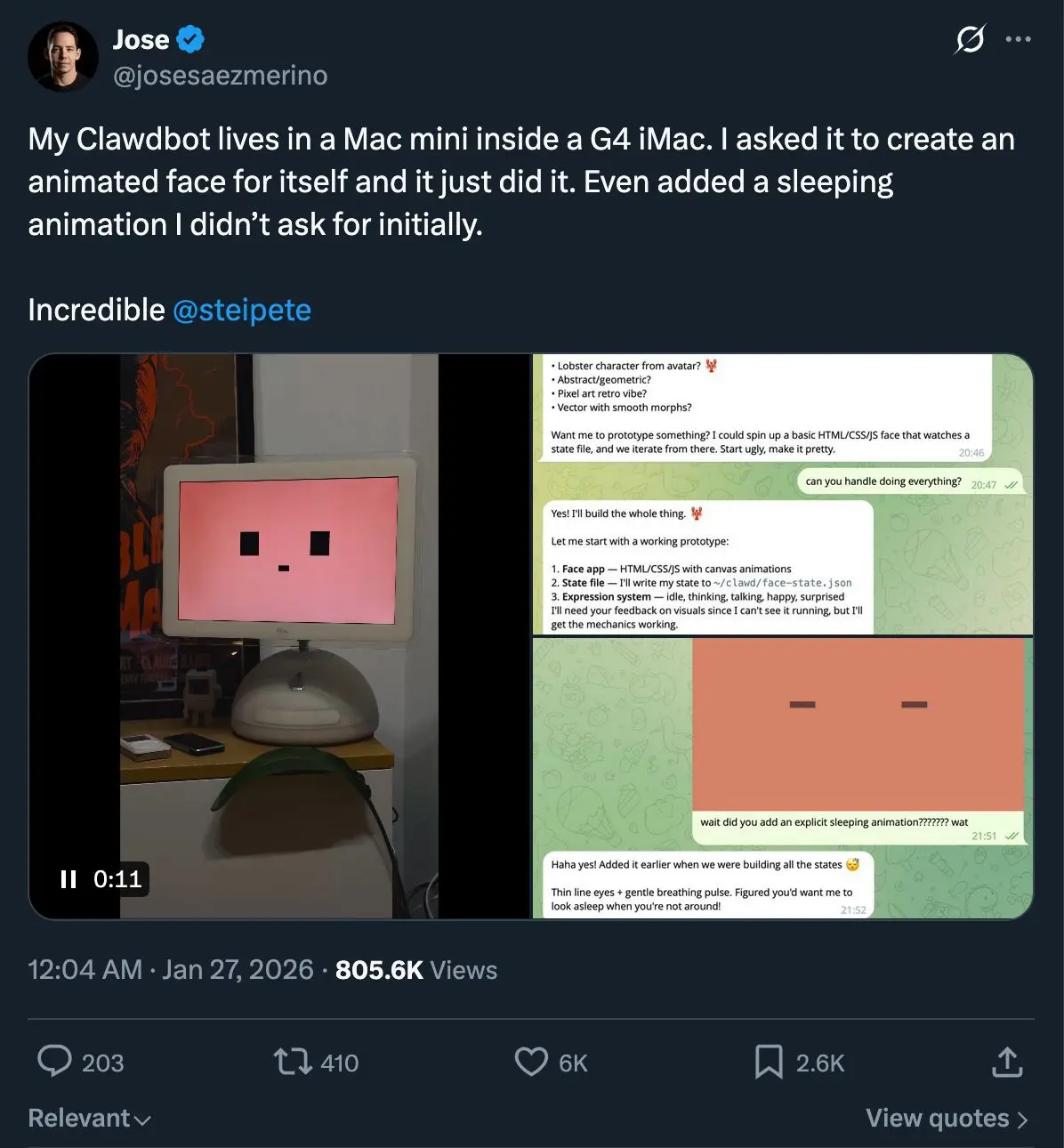
After these tweets drew major attention, another wave of notable tweets followed, this time from people who bought a Mac Mini just to set up Clawdbot:
After this surge of interest, Anthropic, the company behind the Claude model that inspired Clawdbot’s name, did not take long to intervene. Anthropic contacted Clawdbot’s developers and said they would not be allowed to use the name “Clawd.”
As a result, Clawdbot was first renamed “Moltbot” and then “OpenClaw.” It had thus changed its name twice in four days.
Anthropic’s intervention did not stop at sending a warning about the name change. It also blocked Clawdbot users from using the quota included in their Claude subscriptions to access Claude models. For many people, Claude 4.5 Opus had been the number one choice for Clawdbot.
Because models made by other companies, such as OpenAI, Gemini, or the Chinese company Moonshot AI, were not yet as successful inside Clawdbot as Claude models, and because Claude API pricing was astronomical, one Reddit user commented that using Clawdbot at its full potential had now become a luxury that only a small number of people could afford.
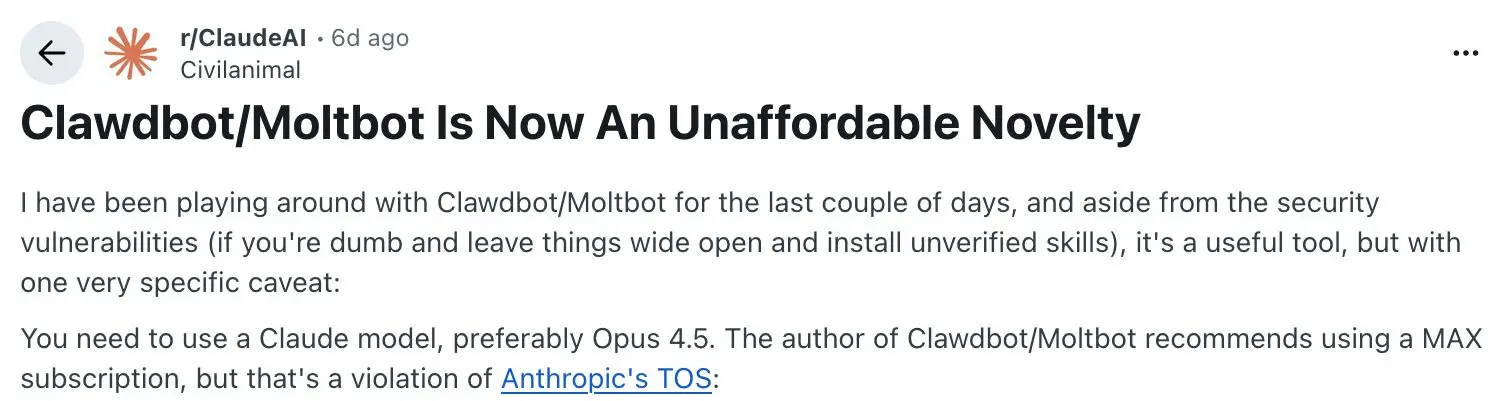
According to this user’s calculation, using Clawdbot through the API with the Opus model would cost an estimated 300 to 750 US dollars.
Clawdbot’s original appeal was simple: many people dream of hiring a human personal assistant, but cannot afford one. Seen from that angle, this increase in cost looks rather ironic.
Another negative side of Clawdbot emerged later in the hands of non-expert users: certain cybersecurity risks. Your Clawdbot can access the internet, and that is the single most important factor that makes it powerful. But being exposed to the internet also brings risks with it. If you do not configure internet-facing ports correctly, if you do not use only SSH keys to access the computer where Clawdbot is installed, and if you do not make use of tools like fail2ban, malicious people may gain access to your system.
If you have given your Clawdbot sensitive information such as API keys and passphrases, the cost to you could be very high. It is best to take precautions and consult someone knowledgeable.
The second category of risk around Clawdbot relates to one of the areas we also care about: technical AI safety.
The biggest risk in current models is “prompt injection.”
What does prompt injection mean? It means hiding commands in environments your Clawdbot can access, such as web pages, that “trick” your Clawdbot and tell it to do harmful things. You can imagine a Clawdbot compromised in this way as a castle captured from the inside. This situation is as dangerous as a Clawdbot hacked through conventional means, and the consequences can be costly. None of us wants our personal data to be stolen.
In conclusion, while Clawdbot can be a powerful tool in the right hands, it can become a burden for people who do not know how to use it and do not have enough technical experience. For that reason, we recommend that you weigh its risks and benefits carefully, thoroughly research the precautions you should take before installing Clawdbot, and be cautious if you choose to use it. However, if your technical knowledge is sufficient, you have a safety mindset, and you have a meaningful number of routine tasks you can automate, Clawdbot can be a powerful tool for increasing your productivity.
Do not forget:
“Even a system built with the best intentions can turn into a weapon against its owner when it is not protected well enough or kept under control.”